
Léonie Sonning Music Prize 2026 goes to conductor Kirill Petrenko
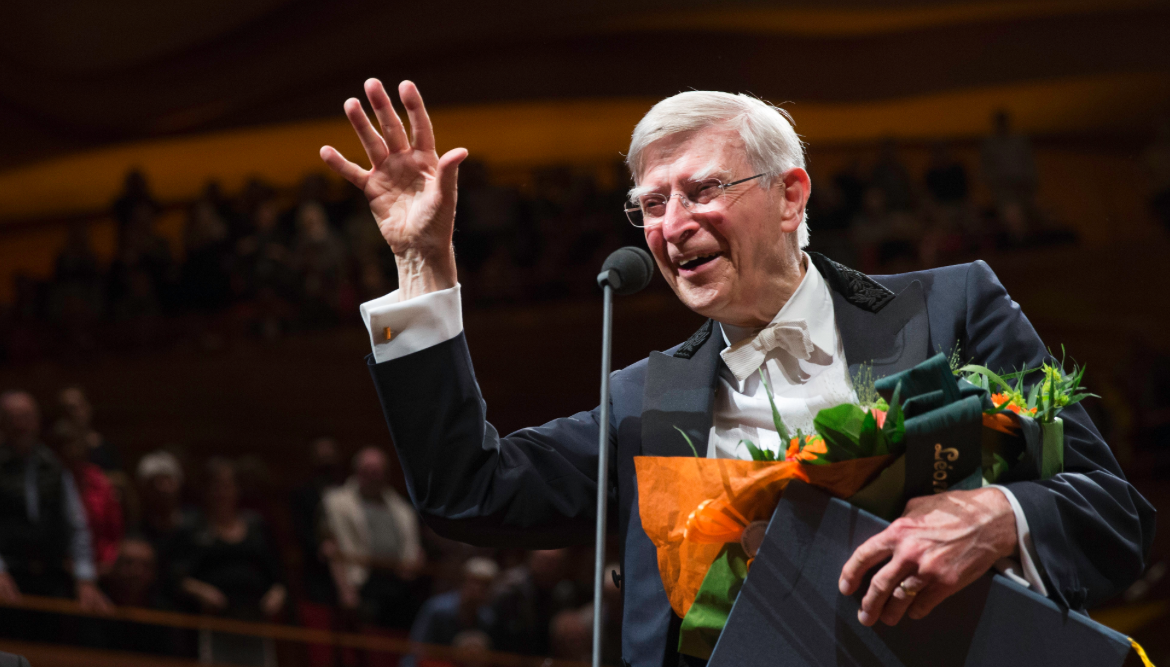
His Majesty The King of Denmark presented the Léonie Sonning Music Prize 2026 to conductor Kirill Petrenko at a gala concert in DR Koncerthuset. Listen to the concert here.
At the award ceremony, His Majesty read the official citation and paid tribute to Petrenko as “an artist of exceptional integrity,” whose work is characterised by “rare precision, depth, and humility” and by an unwavering commitment to the essence of music itself. Through his extraordinary ability to inspire musicians and audiences alike, Petrenko transforms music into “an experience of clarity, intensity, and meaning.”
Accepting the Prize, Petrenko expressed his gratitude for the honour and announced that he will donate the entire prize sum of DKK 1,000,000 to organisations supporting Ukraine.
“Receiving this Prize is an incredible honour for me and a meaningful confirmation of the work I have devoted my life to,” he said.
“As a Russian artist, it is completely shocking for me. People in Ukraine are still trying to live their lives while protecting and defending their sovereignty and their future. I made a decision to donate the money to organisations supporting Ukraine, particularly helping children who have lost their families during the war, and to initiatives restoring the cultural heritage destroyed by the war.”
The award ceremony took place during a festive concert with the DR Symphony Orchestra, conducted by Kirill Petrenko, featuring Mendelssohn’s atmospheric The Hebrides Overture, Schumann’s Piano Concerto with Polina Osetinskaya as soloist, and Strauss’ monumental Also sprach Zarathustra.
The Léonie Sonning Music Foundation warmly congratulates Kirill Petrenko on receiving the 2026 Léonie Sonning Music Prize and thanks him for both his outstanding artistic contribution and acknowledges his generosity in choosing to donate the Prize to organisations supporting Ukraine.


Kirill Petrenko til Danish radio DR P2
Listen to the prize concert and interview here.
FOR THE MUSIC – The Story of Kirill Petrenko
Motivation
Presenting this year’s laureate, board member of the Léonie Sonning Music Foundation Martin Brommann described Kirill Petrenko as an artist who reminds us that “true artistic depth takes time” and whose work is defined by trust, attentiveness and an uncompromising dedication to music itself.
These qualities are at the heart of the Léonie Sonning Music Prize 2026.
His Majesty The King of Denmark presented the award with the following citation:
“The Léonie Sonning Music Prize 2026 is awarded, with a sum of 1,000,000 kroner, to the conductor Kirill Petrenko.
In Kirill Petrenko we recognize an artist of exceptional integrity, whose work is defined not by outward display, but by an unwavering devotion to the essence of music itself.
His artistry is marked by rare precision, depth, and humility. With an uncompromising commitment to the score and an extraordinary ability to inspire those around him, he transforms music into an experience of clarity, intensity, and meaning.
For his outstanding contribution to the art of music, and for the lasting impression he leaves on musicians and audiences alike, it is both fitting and an honour to award the Léonie Sonning Music Prize to Kirill Petrenko.”
What the Danish Press wrote on Kirill Petrenko
Kirill Petrenko and the Danish National Symphony Orchestra, 13 June 2026, DR Concert Hall
“As I sat in the Concert Hall, packed to capacity with audience members and familiar faces from the classical music world, at Saturday’s concert with Petrenko and the Danish National Symphony Orchestra, it was overwhelming to hear the result. After their very first rehearsal period with the recipient of the Léonie Sonning Music Prize, the Danish National Symphony Orchestra simply sounded different from what we are used to hearing.”
“The 54-year-old Petrenko kept the music at a restrained dynamic level while, with simple and precise gestures, he made Mendelssohn’s overture The Hebrides breathe with a remarkably homogeneous and light string sound.”
“Richard Strauss’s tone poem Also sprach Zarathustra is famous for its grandiose effects. In the auditorium of the Concert Hall, they exploded like fireworks against a night sky.”
— Thomas Michelsen, Politiken
Kirill Petrenko and the Danish National Symphony Orchestra,13 June 2026, DR Concert Hall
“They began with a modest-sized orchestra in Mendelssohn’s concert overture The Hebrides (1830), composed following the composer’s impressions of a visit to the rugged Scottish archipelago. This is classical music without the lush sonorities and pathos of Romanticism, and Petrenko placed the magnifying glass on classical performance practice: transparency, almost no vibrato, refined dynamics, and sharply articulated rhythm.”
“Kirill Petrenko had wished for his collaboration with the Danish National Symphony Orchestra to culminate in Richard Strauss’s Also sprach Zarathustra (1896) (…) I cannot recall ever hearing this orchestra play with such confidence and abundance of resources.”
“It was almost unreal to witness the musicians’ mastery of the work’s myriad interwoven motifs, dizzyingly fast string passages, the soloistic tightrope walk of concertmaster Soo-Jin Hong, and the overall control of sound. But they could achieve it because, quite simply, everything was in focus under Kirill Petrenko.”
— Valdemar Lønsted, Information
Kirill Petrenko and the Danish National Symphony Orchestra,13 June 2026, DR Concert Hall
“Petrenko’s interpretation of Richard Strauss’s tone poem Also sprach Zarathustra was magnificent, poetic, and unsentimental all at once.”
“Somewhere in the infinite musical universe, Petrenko borrowed a little of the dawn’s wings and is now inscribed among many others as a shining star who has received one of the finest music prizes. He proved himself worthy of it through music, words, and actions together with the Danish National Symphony Orchestra this Saturday in the DR Concert Hall.”
— Andreas Riis Damgaard, Kristeligt Dagblad
Conductor Festival with the Laureate
In connection with the presentation of the Léonie Sonning Music Prize 2026 to Kirill Petrenko, the Léonie Sonning Music Foundation, in collaboration with DR, the Royal Danish Academy of Music and the Danish Film Institute’s Cinematheque, organised a series of special events in Copenhagen.
Over five days, audiences explored the role of the conductor through film screenings, seminars, discussions and concerts. The programme offered artistic, historical and personal perspectives on conducting, with Kirill Petrenko’s artistry as its focal point.
The festival culminated in the award ceremony and gala concert at DR Koncerthuset, where Kirill Petrenko conducted the Danish National Symphony Orchestra.
About Kirill Petrenko
Kirill Petrenko is widely regarded as one of the leading conductors of our time and has served as Chief Conductor of the Berlin Philharmonic since 2019. He is renowned for his exceptional musical precision, profound understanding of the score, and his ability to create performances of remarkable intensity and vitality in both the symphonic and operatic repertoire.
Born in Omsk, Russia, and raised in Austria, Petrenko has held leading positions including General Music Director of the Bavarian State Opera in Munich and has appeared with many of the world’s foremost orchestras and opera houses. Throughout his career, he has earned the admiration of musicians and audiences alike through his uncompromising artistic integrity and deep commitment to music.